
Jump to:
SUMMARY
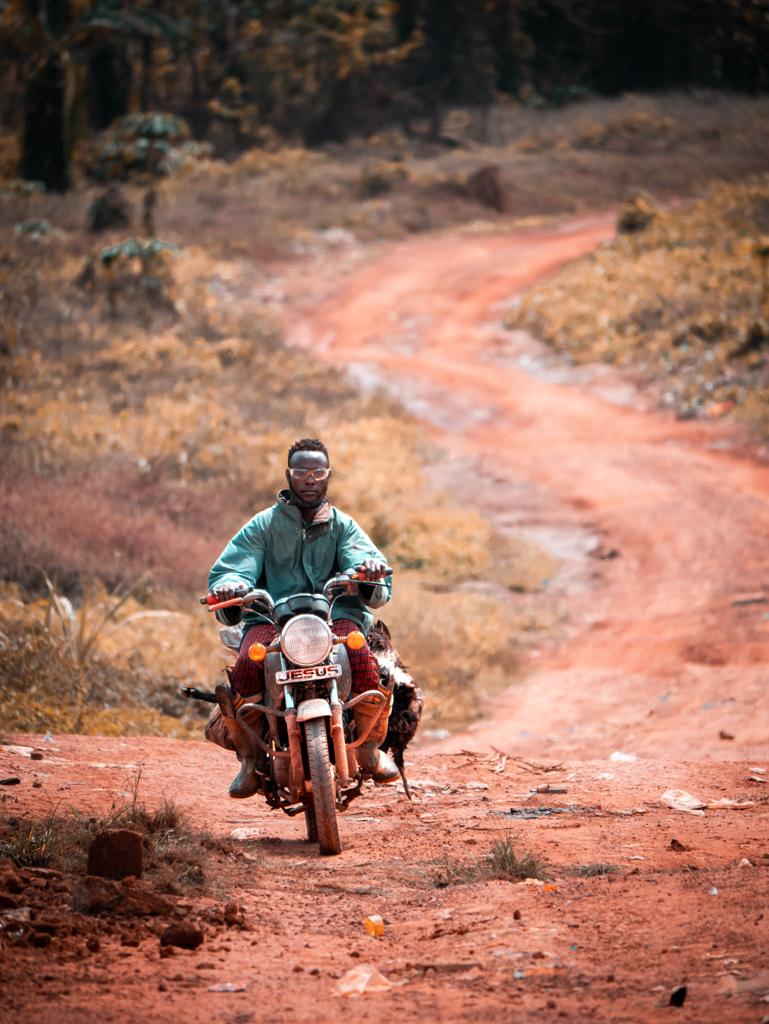
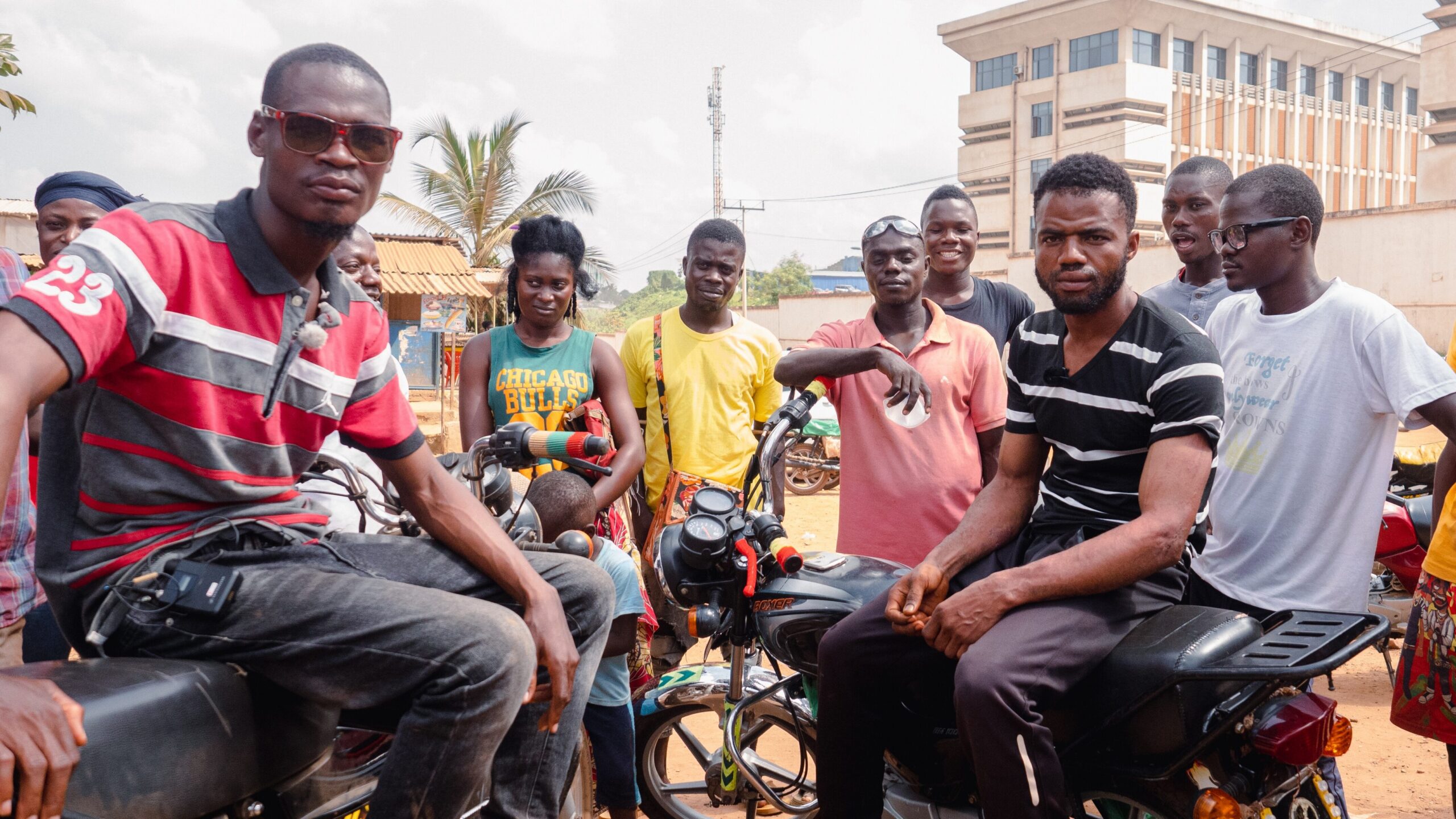
Ex-combatants originated Liberia’s motorcycle taxi sector, and conflict-affected youth make up the vast majority of its estimated 175,000 ‘riders’ (drivers). Motorcycling emerged after Liberia’s civil war as a critical economic sector. It provides cyclists with economic livelihood opportunities and constitutes a space of socio-political youth mobilisation. Through motorcycling, young riders also establish themselves as active peacebuilding agents, enacting their own ideas to counter the insecurity and marginalisation of post-war life. Motorcycling offers a unique vantage point to understand the long-term post-war challenges facing youth and the multiple roles that young people play after war.
This ongoing, multi-year project by Jaremey McMullin started in 2018 and draws from qualitative interviews, focus groups, and participant observation with young cyclists, union leaders, the motorcyclists’ security force (Task Force), and government and civil society stakeholders across multiple sites in Liberia, focused on parking stations (taxi ranks) in Monrovia, Weala Town, Ganta (Gompa City), Tubmanburg, Bo-Waterside, Robertsport, Toe Town, Zwedru, Bartejan Gold Camp, Pleebo, and Harper.
CONNECTING MOTORCYCLING & PEACEBUILDING
The project’s objectives are, first, to interpret the multiple meanings (economic, social, and political) that ex-combatant and conflict-affected youth attach to their participation and association in motorcycling; and second, to analyse how motorcycling is simultaneously a conflict-producing and conflict-mitigating site within post-war Liberia.
Research questions include: How do ex-combatants articulate the significance and meaning of livelihood activities, and in what ways do they articulate motorcycling as a site of post-war well-being? How do they relate labour mobilisation to broader post-war political reintegration? How do young people generate and contribute their own peacebuilding strategies after war? And, how can research approaches better collaborate with youth actors to counter ongoing forms of economic, social, and political marginalisation?
Platform for Dialogue and Peace (P4DP), a Liberian peacebuilding NGO involved in research and participatory action activities to prevent, manage and transform conflict through collaborative action, has provided critical research assistance throughout the project. P4DP has also been the national implementing partner for all project impact generation activities. James S. Shilue, P4DP’s Executive Director, is a co-investigator on the project.
PROJECT FUNDING
Successive grants from the SFC ODA GCRF have funded the project, under the heading ‘Motoring from War to Peace’. Grant details are:
- 2020–2021; £12,500. ‘Violence Prevention and Livelihood Support in Liberia through Police-Cyclist Dialogue.’ [#SFC/AN/12/2017]
- 2019–2020; £23,074. ‘Supporting Social Reintegration of Liberia’s Conflict-Affected Youth through Nationwide Counter-Stigma Efforts.’ [#SFC/AN/04/2019]
- 2018–2019; £9,822. ‘Motoring from War to Peace: Understanding Long-Term Reintegration Trajectories of Ex-Combatant Youth in Liberia’s Motorcycle Taxi Unions.’ [#SFC/AN/02/2018]
- 2018–2019; £8,057. ‘Commercial Motorcyclists as Peacebuilders: Combatting Social Marginalization and Supporting Educational Attainment, Business Skills, and Safety & Security of Conflict-Affected Youth in Liberia.’ [#SFC/AN/02/2018]
- 2017–2018; £28,113. ‘Motoring from War to Peace: Understanding Long-Term Reintegration Trajectories of Ex-Combatant Youth in Liberia’s Motorcycle Taxi Unions.’ [#SFC/AN/12/2017]
Folke Bernadotte Academy, the Swedish Government Agency for Peace, Security, and Development, also provided funding to evaluate the impact of cyclists’ own ideas about how to promote peacebuilding, livelihood, and educational attainment of youth engaged in the sector. The funding provided ten educational scholarships at high school, vocational, and university level to selected cyclists. The grant also provided numeracy and business skills training for cyclists at selected parking stations (taxi ranks):
- 2021–2022; ‘Motorcycling as Post-war Reintegration: Assessing Youth Peacebuilding Strategies in Liberia,’ SEK 348,900/£29,756. [#20-00280]
Photo: Photo by Florian Reichelt, Cinematographer – for Motorcycling as Peacebuilding (PI Jaremey McMullin)
RESEARCH PUBLICATIONS
Research publication outputs from the project have analysed multiple topics that represent major contributions to peace studies, youth studies, urban geography, and African studies. Those topics include: youth agency; youth identity as peacebuilders and post-war contributions to peacebuilding; youth-centred peacebuilding strategies and youth narration of post-conflict transition; gender mainstreaming and gendered identities in the motorcycle taxi sector; and the interplay between social marginalisation, belonging, quests for recognition, and economic livelihood.
These outputs have also critiqued the securitisation of ex-combatant reintegration, arguing instead to understand how dominant disarmament, demobilisation, and reintegration approaches tend to stigmatise ex-combatants in ways that work against and not for their post-war integration. And, they have explored links between documentary filmmaking and subject-centred accounts of peace and peacebuilding by drawing the documentary film series, Liberia: Legacies of Peace, that also resulted from the project.
Publications
Peer-reviewed journal articles and other publications resulting from the project are:
Forthcoming Publications
Forthcoming publications arising from the project focus on:
- Impact of union politics on post-war reintegration of ex-combatants and conflict-affected youth;
- Urbanisation and Liberian youth;
Cyclists’ counter-stigma efforts and corresponding impacts on social integration and inclusion - Violence prevention impacts of police-cyclist dialogue
- Linkage between ex-combatant reintegration and security sector reform (SSR)
Project Filmography
The project has also produced several documentary films. These films have explored everyday spaces where peacebuilding takes place and the everyday actors who do the hard work of peace (youth, women peace activists, demobilized army personnel, and veteran diamond miners). The films analyse how to ‘see’, ‘site’, and recognise contributions to peacebuilding from these diverse actors, and how understanding of what peace is shifts in the process.
All films directed and produced by Jaremy McMullin.
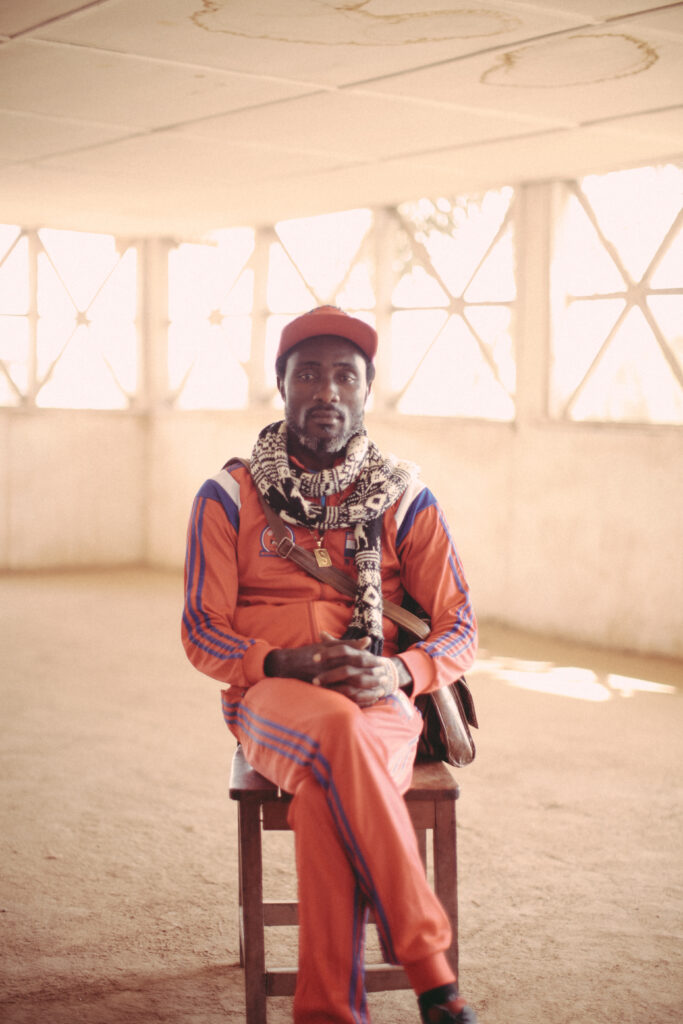
- Sarty (2026). A long-time motorcyclist union leader and ex-combatant from Gompa City (Ganta) in northern Liberia narrates how motorcycling has contributed to peace in Liberia and identifies the many challenges facing cyclists.
- Business Skills Training: Participant Reflections (2023). Film output linked to Swedish government-funded research project assessing youth peacebuilding strategies in the motorcycle taxi sector in Liberia.
- Liberia: Legacies of Peace (2019). Documentary short film series on everyday peace and peace actors, comprised of five films: Best Man Corner (2019); Diamond Boys (2019); Peace Hut (2019); Pink Panther (2019); and 540 (2019).
- Community Perceptions of Commercial Motorcyclists in Liberia (2019). Short film used in community-motorcyclist and police-motorcyclist dialogue groups to prevent violence, police brutality, and exploitation of cyclists.
Photo: Production still from Sarty, directed by Jaremey McMullin, cinematography by Matthew Hyndman.
PUBLIC ENGAGEMENT
The project has involved extensive public engagement with international organisations, national and donor agencies, and think tanks. UN-level engagement has promoted long-term measurement of ex-combatant reintegration trajectories and outcomes; encouraged adoption of youth-centred methodologies and implementation of youth-led peacebuilding strategies; and, contributed to re-thinking policies of international assistance based on analysis of past gender mainstreaming and sustainable livelihood interventions.
Key public engagement activities, some funded by the University of St Andrews Impact and Innovation Fund, have taken several forms:
Keynote Lectures
- Institute for Autonomy and Governance (The Philippines), International Conference on After the Peace Agreements: Bangsamoro and Beyond; Distinguished Speaker, ‘Ex-Combatants, After the Peace Agreement,’ Manila, 17–19 November 2025
- Pacific Lutheran University, 7th Biennial Ambassador Chris Stevens Celebration of Service; Keynote Presentation, ‘Motorcycling and Peacebuilding: Re-Framing Narratives in Documentary Filmmaking,’ 3 March 2025.
- United States Agency for International Development, Disengagement and Reintegration Training Workshop; Keynote Research Presentation, ‘Community Reintegration and Reducing Stigma,’ 7–10 October 2024.
Invited presentations and consultations from international organisations and national governments
- Folke Bernadotte Academy, Sweden’s government agency for peace, security and development; ‘Liberia and the Role of Young People in Peacebuilding,’ 29 September 2023.
- Integrated Disarmament, Demobilization and Reintegration Training Group (IDDRTG) and Bonn International Center for Conflict Studies (BICC); Extraordinary Meeting of the IDDRTG, Nairobi, 3–6 July 2023.
- United States Institute of Peace, Interagency Deep Dive on a Framework for Rehabilitation and Reintegration, Reducing Stigma and Facilitating Social Belonging; ‘Counter-Stigma Activities,’ 28 October 2023 [virtual].
- IDDRTG and BICC, Extraordinary Meeting of the IDDRTG in Bogota and Cali, Colombia, 11–16 July 2022.
- IDDRTG & BICC, Extraordinary Meeting of the IDDRTG in Accra, Ghana, 4–5 November 2021.
- United States Institute of Peace, consultation on ‘Stigma Reduction,’ for USIP’s national draft guidance on Violent Extremist Disengagement and Reconciliation, 2 July 2021 [virtual].
- United Nations Special Rapporteur on the Rights of Persons with Disabilities; Expert consultation on Disability and Armed Conflict, 4 June 2021 [virtual].
- United Nations Department of Peace Operations/Office of Rule of Law and Security Institutions/Disarmament, Demobilization, and Reintegration Unit and the research group on UN Media and Peace Processes (RUNMAPP) at the Centre for Freedom of the Media (CFOM) at Sheffield University, consultation on ‘Research Perspectives on the Public Information and Strategic Communications during Disarmament, Demobilization, and Reintegration (DDR),’ 25 June 2020 [virtual].
- Swedish Development Cooperation Agency and Folke Bernadotte Academy, Research-Policy Dialogue Workshop, Implementation of Swedish Bilateral Development Cooperation Strategy for Liberia; ‘Contributing to a Peaceful, Inclusive and Sustainable Society in Liberia,’ 18 June 2020 [virtual].
- United Nations Department of Peace Operations, Office of Rule of Law and Security Institutions, Security Sector Reform Section and Folke Bernadotte Academy, Research-Policy Dialogue, ‘Security Sector Reform in Fragile and Conflict-affected States: Towards the Next Generation?’; ‘Community-Motorcyclist-Police Tensions & Insecurity in Liberia: Violence Prevention & Reduction Strategies and Non-Formal/Formal Security Cooperation,’ New York, 6 September 2019.
- United Nations Department of Peace Operations/Office of Rule of Law and Security Institutions/Disarmament, Demobilization and Reintegration (DDR) Section; ‘Assessing and Conceptualizing Long-term Reintegration Outcomes,’ New York, 24 July 2019.
Peer review invitations from international organisations and global nonprofits
- United Nations Development Programme. Peer review of Integrated Disarmament, Demobilisation, and Reintegration Standards, guidance on disability (2026).
- Transparency International. Peer Review for Liberia of 2025 Government Defence Integrity Index (GDI), Transparency International Defence and Security Programme (2025).
- United States Institute of Peace, Violent Extremism Disengagement and (Re)integration Action Guide, peer review of ‘Module 3: Reduce Stigma’ (2022).
Invited Film Screenings from International Organisations and International Research Institutes
- British Permanent Mission to the United Nations, ‘Pink Panthers: Gender, Peacebuilding, and Motorcycling in Liberia,’ a presentation and film screening of Pink Panther, New York, 6 December 2019.
- United Nations University, War Child, and United Nations Children’s Fund (UNICEF), ‘Nothing About Us Without Us: Participatory Policy Research with Children and Youth Affected by Conflict’; ‘Youth-Designed and -Led Support in Liberia’ and film screening of Best Man Corner, UNICEEF House, New York City, 25 November 2019.
- The Graduate Institute Geneva, Second International Conference on Environmental Peacebuilding, screening of Diamond Boys, 1 February 2022.
- New York University, Center for Global Affairs; ‘Pink Panthers: Gender, Peacebuilding, and Motorcycling in Liberia’ and screening of Pink Panther, 4 December 2019.
- Lund University, Gender Research Group; ‘Gender, Livelihood, and Conflict-Affected Youth: The Case of Commercial Motorcycling in Liberia’ and screening of Pink Panther, 28 May 2018.
COUNTER-STIGMA & SOCIAL REINTEGRATION (FILM)
Young motorcycle taxi drivers face critical challenges often unaddressed by development assistance: health and safety threats, police brutality and exploitation, and ongoing, serious social stigmatisation. Social reintegration assistance has also been under-prioritised more broadly in DDR assistance for ex-combatants and conflict-affected youth after war. The Motorcycling as Peacebuilding project has worked with hundreds of cyclists for a decade to identify the drivers of social stigmatisation and to analyse and support young people’s own strategies to counter it.
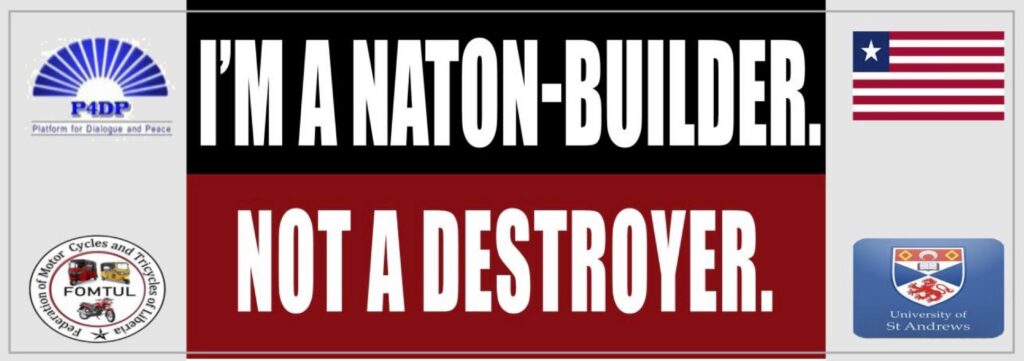
Several collaborative research activities have focused on redressing social stigmatisation in the sector. From 2020–2023, the project convened police-cyclist dialogue groups in areas where violence traced back to police-cyclist tensions had occurred. From 2020–2021, it implemented a nationwide bumper sticker campaign and series of radio broadcasts, designed to educate cyclists about road safety and violence prevention, and to educate communities about cyclists’ contributions to economic growth, peacebuilding, and reintegration. The bumper stickers and radio broadcasts highlighted the key role that cyclists played during the Ebola crisis from 2014–2016 and evidenced the active role cyclists played preventing the spread of COVID-19 and managing its effects on vulnerable communities.
In 2019, the project also produced a short film on community perceptions of commercial motorcyclists to use in counter-stigma dialogue between communities and cyclists (2019–2020), in police-cyclist dialogue (2020–2023), and in the project’s successive focus group discussions (2019–2023).
Community Perceptions Film used in Cyclist-Community Dialogue Groups
Runtime: 15:44 mins
Main Credits
Director/Producer: Jaremy McMullin
Camera: Matthew Hyndman
Editor: Tanja Schangin
Research Assistance: Kennedy K. Berrian
IMPACT GENERATION ACTIVITIES
In collaboration with P4DP, the project has designed and implemented several impact-generation activities in Liberia, working closely with parking station managers, the commercial motorcyclists’ unions and national federation (FOMTUL), and regular cyclists.
Key project impact activities and outcomes are:

2020 POLICY REPORT
‘The Legacy of DDR in Liberia,’ commissioned by the United Nations Department of Peace Operations, Office of Rule of Law and Security Institutions, Disarmament, Demobilization and Reintegration Section (2020). 40pp.
Photo by Florian Reichelt, Cinematographer – for Motorcycling as Peacebuilding (PI Jaremey McMullin)
2023 POLICY REPORT
‘Project Evaluation & Policy Recommendations, P4DP-HD Peace Dividends Project: Facilitating Community Dialogues to Strengthen Peacebuilding and Social Cohesion,’ prepared for Platform for Dialogue and Peace (P4DP), Centre for Humanitarian Dialogue (HD), and the United Nations Peacebuilding Fund (2023). 19pp.
2019 Community-cyclist dialogue groups
Four groups convened to discuss peaceful dispute resolution and to gauge impact of community perceptions and stigma of cyclists.
2020-2023 POLICY-CYCLIST DIALOGUE GROUPS
24 groups convened to discuss and mediate prevention of roadside accidents, police-cyclist violence, youth violence prevention, and social inclusion of cyclists
2019 Nationwide bumper sticker campaign
5,000 bumper stickers written and designed by cyclists to counter social marginalisation and address other themes of key importance to them.
2019 ‘FOMTUL Hour’ radio broadcasts
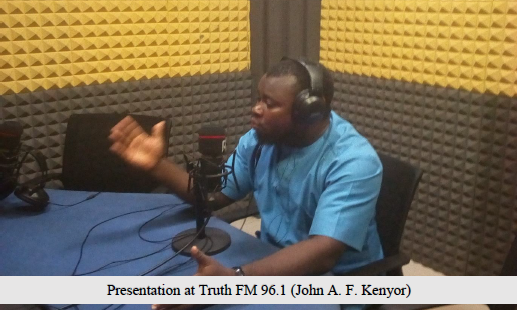
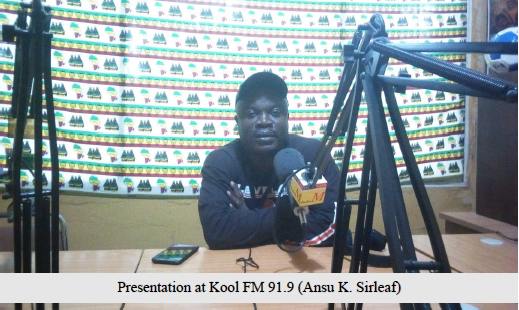
Weekly radio broadcasts across three nationwide stations (Cool FM 91.9 FM, Radio Monrovia 92.1 FM, and Truth 96.1). The Federation of Motorcyclists and Tricyclists Unions of Liberia (FOMTUL) wrote and produced the broadcasts, which highlight challenges of police brutality and exploitation, violence prevention, roadside accidents, social stigma of motorcyclists, and livelihood issues linked to COVID-19.
Listen here:
Photo by FOMTUL – for Motorcycling as Peacebuilding (PI Jaremey McMullin).
INVITED TALKS & PAPERS
TALKS
- ‘The Role of Responsible Business Conduct in Natural Resource Management – The Case of Sustaining Peace in Liberia,’ Second International Conference on Environmental Peacebuilding, The Graduate Institute Geneva, Roundtable organized by Swedwatch, 3 Feb 2022;
- Film Screening of Diamond Boys, Second International Conference on Environmental Peacebuilding, The Graduate Institute Geneva, 1 Feb 2022;
- ‘Between Concepts and Reality: How to Deal with Armed Groups in Transition Phases of Violent Conflict?’ Bonn International Centre for Conflict Studies (BICC) International Conference, 11-12 Nov 2021;
- Discussion and Q&A of Best Man Corner, Toronto Motorcycle Film Festival, moderated by Kristen Midura (Founder, Engines for Change), 24 Sept 2021;
- ‘Extraction and Erasure,’ Mimesis Documentary Festival, University of Colorado Boulder, live panel discussion with MDF filmmakers around representational media’s engagement with extraction, 9 Aug 2021;
- ‘Ex-combatants’ Counter-Stigma Strategies and The Stigmatising Politics of Disarmament, Demobilisation and Reintegration,’ King’s College London, 30 June 2021. Plus film screening of ‘Community Perceptions of Commercial Motorcyclists in Liberia’.
- ‘Livelihoods for Conflict-affected and Ex-combatant Youth: The Case of Commercial Motorcycling in Liberia,’ Centre for Conflict Studies, Philipps-University Marburg, 10 Dec 2019. Plus film screening of Best Man Corner.
- ‘Pink Panthers: Gender, Peacebuilding, and Motorcycling in Liberia,’ Center for Global Affairs, New York University, 4 Dec 2019. Plus film screening of Pink Panther.
- ‘Seeing Ex-combatants, Siting Reintegration within Liberia’s Motorbike Hustle,’ Centre for Peace Studies, University of Tromsø, 15 Nov 2019. Plus film screening of Best Man Corner.
- ‘Youth Reintegration Trajectories,’ Faculty of Political Science, University of Belgrade, 8 Nov 2019. Plus film screening of Best Man Corner.
- ‘“Put Down” But Not Out: Demobilized AFL Personnel in Liberia and Implications for DDR/SSR,’ Folke Bernadotte Academy, Stockholm, 4 Apr 2019;
- ‘Livelihoods for Conflict-affected and Ex-combatant Youth: The Case of Liberia,’ Danish Institute for International Studies, Copenhagen, 30 May 2018;
- ‘Gender, Livelihood, and Conflict-affected Youth: The Case of Commercial Motorcycling in Liberia,’ Lund University, Gender Research Group, 28 May 2018.
PAPERS
- ‘Motorcycling as Post-War Reintegration: Assessing Youth Peacebuilding Strategies in Liberia,’ Folke Bernadotte Academy (Sweden’s government agency for peace, security and development), FBA Research Day, 28 Sept 2023;
- ‘“Suffering That Only Men Can Withstand”: Gendered Aspirations and Distortions in Research with Conflict-affected Youth in Liberia,’ International Studies Association Annual Convention, Montreal, March 2023.
- ‘“What Is the Benefit of this Project? Space, Representation, Participation, and Impact Generation in Research on Conflict-affected Youth,’ Varieties of Peace Network, University of Uppsala, ‘Challenges of Making Peace Researchable—Methodological Pluralism, Opportunities and Pitfalls,’ 9-10 June 2021;
- ‘SSR Is from Mars, DDR Is from Venus: Gendered Need Interpretation during Liberia’s Security Sector Reform Process,’ Eberhard Karls Universität Tübingen, ‘Analysing Gender, Practices, and Social Change,’ 14-15 Jan 2021;
- ‘Always Re-integrating: Ex-combatants’ Counter-Stigma Strategies and The Stigmatising Politics of DDR,’ Folke Bernadotte Academy/Politics after War Research Group/United Nations DPO/OROLSI/DDR Section, ‘From Armed to Non-Armed Politics: A series of virtual seminars initiating a research-policy dialogue on the political dynamics of disarmament, demobilization, and reintegration (DDR), 4 Dec 2020;
- ‘“Put Down” But Not Out: Demobilized AFL Personnel in Liberia and Implications for DDR/SSR,’ Folke Bernadotte Academy and New York University, New York City, ‘Security Sector Reform in Fragile and Conflict-affected States: Towards the Next Generation?’ 4-5 Sept 2019;
- ‘Motorcycling as Relational Peace in Liberia,’ University of Uppsala, ‘Varieties of Peace: Relational Peace,’ 7-8 May 2019;
- ‘Livelihoods for Conflict-Affected and Ex-Combatant Youth: The Case of Commercial Motorcycling in Liberia,’ Folke Bernadotte Academy, Stockholm, ‘Recidivism, Recycling or Reintegration? Revisiting DDR,’ 3-4 Nov 2018.
All photos unless otherwise indicated by Florian Reichelt or Matthew Hyndman – for Motorcycling as Peacebuilding (PI Jaremey McMullin).
Research assistance and facilitation in Liberia provided by: Florian Reichelt, Eli Harris-Trent, Matthew Hyndman, Kennedy K. Berrian, Moses S. Sah, James S. Shilue, A. John F. Kenyor, Trokon G. Gray, Emmanuel A. A. Sarty, Alexander T. Devine, Emmanuel B. Morris, Lawrence S. Kromah, Maude V Yardamah, and Victor S. Malu.
